


Key Takeaways
- The "SIDWTDW" File Concept - The blog introduces the original concept of a "Stuff I Don't Want to Deal With" (SIDWTDW) file as a practical way to manage decision fatigue by intentionally setting aside certain decisions until mental energy is refreshed. This represents a novel organizational approach to decision management not attributed to any external source.
- The Morning vs. Evening Decision Quality Framework - The blog presents a structured comparison of how decision quality changes throughout the day across different life domains (food choices, work decisions, communication, etc.). This systematic breakdown of decision deterioration patterns in everyday contexts is an original synthesis not cited from external research.
- The Decision Context Hierarchy - The blog establishes an implicit hierarchy of decision importance, suggesting that seemingly trivial decisions (like choosing water vs. soda) can become mentally taxing under conditions of prior decision depletion. This contextual understanding of how decision importance is relative to mental state represents an original perspective.
- The "Crisis Reset" Theory - The blog mentions a personal hypothesis that "in a crisis, all systems come back online," suggesting the author's theory that emergency situations might temporarily override decision fatigue. While noting there's no data to support this, the proposition itself represents original thinking that could inspire further investigation.
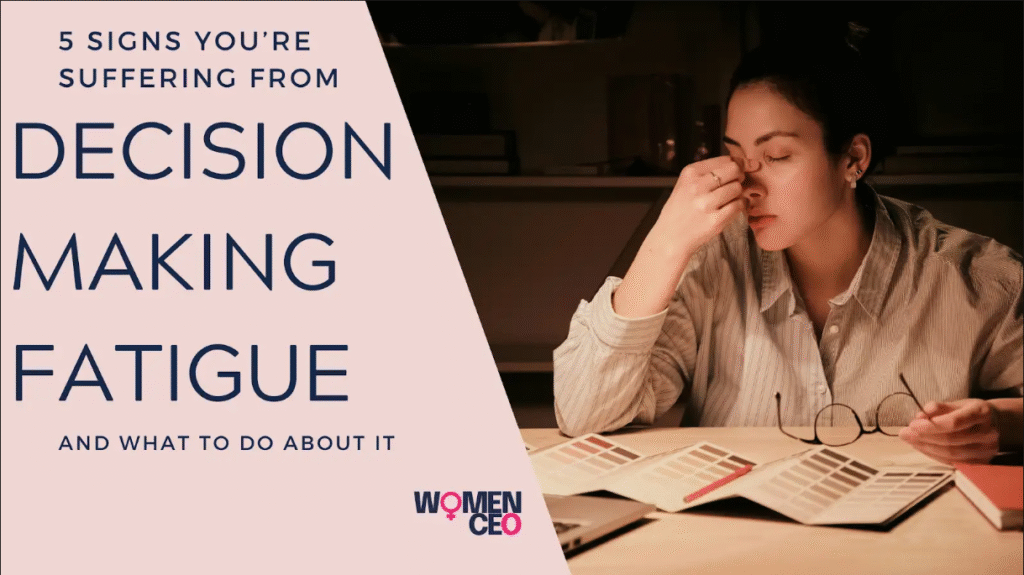
Table of Contents
Toggle5 Signs You're Suffering from Decision Making Fatigue, and How to Save Yourself
I was standing in line to get into my son’s school play when a student asked if I’d like some water or a soda for “only $2 to help towards field trip costs.” This may stump some people, but we live in the desert. The answer to a choice between beverages is water, it’s always water. Except that day, I was at the end of a full day of client meetings, budget planning, and resolving a staff conflict, and my brain had simply shut down. I was experiencing decision making fatigue. Let’s dive into what’s actually happening in your brain when decisions become overwhelming, and more importantly, how to fix it.
What is Decision Making Fatigue?
Think of your ability to make decisions like a gas tank that gradually empties throughout the day. Each choice—from what to wear to which project to prioritize at work—drains a little fuel from the tank.
This phenomenon was studied by Dr. Roy Baumeister, who found that judges were significantly more likely to grant parole to prisoners whose cases were heard in the morning compared to those heard late in the day. After making decisions all day, the judges’ mental resources were depleted, leading to a perceived safer default choice of denying parole.
Most of us are making approximately 35,000 decisions every day.
How to Define Decision Fatigue
Decision fatigue symptoms result from constant mental strain show up in predictable ways throughout our daily routines.
I like to believe that in a crisis, all systems come back online, but I’m not sure I have any data to back that theory up.
Understanding Decision Fatigue Symptoms
Understanding the patterns in our daily routines helps us recognize when we’re experiencing the effects of mental depletion and take steps to preserve our decision-making energy for what matters most.
What are the Signs of Decision Fatigue?
Indecisiveness
The most obvious symptom hits when routine choices become inexplicably difficult.
Last month, I watched my normally decisive friend—a surgical nurse who makes life-or-death decisions—stand paralyzed in front of her closet before a dinner party. “I just can’t decide what to wear,” she sighed. “And honestly, I don’t even care anymore.” After a week of critical decisions at the hospital, even this simple choice overwhelmed her.
Decision fatigue temporarily reduces your ability to choose efficiently, even if you’re typically decisive.
Mental Exhaustion
Sometimes referred to as brain fog, this is a classic symptom of decision exhaustion.
Impulsive Choices
You’re more likely to make impulsive choices or take shortcuts when your batteries are low.
Towards the end of the day, unless I prepped really hard the Sunday before, I am ordering take-out most days of the week because cooking seems like the most overwhelming task ever invented.
The brain wants the path of least resistance.

Avoidance of Decisions
Procrastination becomes the default when you’re suffering from choice fatigue. You might leave emails unread, delay responding to invitations, or put off planning that family vacation.
When Dr. Martin Sanders surveyed 212 business professionals, 64% reported regularly postponing decisions when experiencing high decision fatigue. One respondent admitted: “I have a separate email folder labeled ‘decisions’ where I put anything that requires thought. Sometimes it grows to 50 emails before I tackle it.”
I’ve caught myself doing something similar—leaving important paperwork in a “to deal with later” pile that inevitably grows larger until it demands attention. I actually have a file called “SIDWTDW” – for Stuff I Don’t Want to Deal With.
Overwhelming Anxiety during Decision Overload
For many people, decision overload can trigger anxiety. The fear of making the wrong choice becomes paralyzing.
This anxiety creates a vicious cycle: stress depletes mental energy, making decisions harder, which increases stress further. It’s a nasty cycle that can spiral out of control.

The Natural Consequences of Choice Fatigue
Cue the Jaws theme song.
Impact on Daily Life
When suffering from decision overload, you might notice:
- Bad meal choices
- Time wasted (I once spent 45 minutes reading reviews before buying a $6 stapler)
- Money spent on a whim (like shopping on Amazon late at night, anyone?)
- Important tasks left undone
- Strained relationships (yoo-hoo. Guilty)
Sleep quality generally goes down as well. Harvard research shows that not being able to make judgments might make your mind race and keep you from sleeping.
Professional Implications
Decision fatigue can hurt your productivity in a number of ways:
- Taking longer to finish everyday chores
- Making mistakes in judgment, like the financial advisor who said he gave more conservative advice later in the day
- Having trouble setting priorities
- Less creative thinking
Other common workplace effects include difficulty prioritizing effectively, reduced creative thinking, and what many leaders describe as “leadership lapses”—those moments when you default to avoiding decisions rather than making them. Research backs this up: one comprehensive study found that healthcare providers made progressively more prescription errors as their shifts progressed, serving as a sobering reminder that decision fatigue affects even the most highly trained professionals.
Strategies to Combat Decision Fatigue
Fortunately, you don’t have to accept decision fatigue as inevitable. There are several practical approaches that can help you preserve your mental energy and maintain clear thinking throughout the day.
Simplify Choices
Reducing decisions is the most effective strategy. Some ways to do this:
President Barack Obama famously limited his wardrobe to only gray or blue suits. “I don’t want to make decisions about what I’m eating or wearing because I have too many other decisions to make,” he told Vanity Fair.
You don’t need to be quite so extreme, but consider:
- Creating a capsule wardrobe with mix-and-match items
- Setting up automatic bill payments
- Meal planning for the week
- Having go-to gifts for common occasions
My neighbor Jen, a busy attorney and mother of three, swears by her Sunday meal-prep ritual. “We eat the same breakfast options each day of the week. It sounds boring, but it frees up mental space for decisions that actually matter.”

Establish Decision-Making Routines
When you turn decisions into habits, they stop depleting your mental energy. How To ADHD Youtube influencer has a great video on this to help set up routines that means one task always follows a trigger task, so you don’t even have to think about it.
Try scheduling important decisions for the morning, when your brain is fresh. One CEO I interviewed tackles his three most consequential decisions before 10 AM each day.
Sometimes the best routine is creating a consistent decision-making process. When faced with a tough choice, ask yourself:
- What are the facts?
- What are my options?
- What are potential outcomes of each option?
- Which option best aligns with my values or goals?
This framework saves energy by eliminating the need to create a new approach for each decision.
Delegate Responsibilities
Roughly paraphrasing, Einstein once said to never commit to memory what you can write down. If a man known for little else other than his brilliance tells you to write things down, I think that holds the same weight as delegating responsibilities. You don’t have to be responsible for remembering everything, just as you don’t have to be responsible for deciding everything.
Share the load with partners, family members, or colleagues.
At work, properly delegating decisions to team members not only reduces your load but also empowers others. A manager at Microsoft told me his team’s productivity jumped when he stopped requiring his approval on routine decisions.
Take Regular Breaks
Your brain needs downtime to recharge its decision-making batteries.
Even a 10-minute walk outside significantly improves decision-making performance. That’s a pretty easy experiment you can test out yourself.
Prioritize Self-Care
Self-care is not a dirty word. You are protecting yourself, and let’s face it, your sanity.
Your physical condition directly impacts your mental capabilities. Decision quality plummets when you’re:
- Sleep-deprived (after just one night of poor sleep, decision-making ability drops by up to 50%)
- Hungry (the term “hangry” exists for good reason)
- Stressed (cortisol impairs prefrontal cortex function)
- Sedentary (exercise boosts cognitive function)
Decision making fatigue doesn’t have to derail your effectiveness or wellbeing. By recognizing the signs—indecisiveness, mental exhaustion, impulsivity, avoidance, and anxiety—you can pivot to protect your mental resources.
To quote Dr. Baumeister, “The best decision-makers are the ones who know when not to trust their own decision-making.”
References
1 Baumeister, R. F., & Tierney, J. (2011). Willpower: Rediscovering the Greatest Human Strength. Penguin Books.
2 Pignatiello, G. A., Martin, R. J., & Hickman Jr, R. L. (2020). “Decision fatigue: A conceptual analysis.” Journal of Health Psychology, 25(1), 123-135.