


You’ve built something real. Now you need a room where that actually matters — where the conversation starts at strategy and skips the basics, where the people around you have run teams, managed budgets, and made hard calls. That’s what the right women’s executive network is supposed to give you.
The problem is that the most talked-about options (Chief and Ellevate) come with significant trade-offs: a 60,000-person waitlist, price tags that rival a car payment, but once you make it in, that is the place to be! And the hugely popular Ellevate unfortunately shut its doors.
This comparison breaks down what Chief, Ellevate (during their peak days to make it so popular), and WomenCEO actually deliver across cost, access, mentorship quality, and fit, so you can decide where your time and money belong.
Table of Contents
Toggle1. Quick Comparison: Chief vs Ellevate vs WomenCEO
Chief |
Ellevate |
WomenCEO | |
|---|---|---|---|
Annual Cost
|
$5,900
|
$60 – $1,800
|
Free (founding $10/mo)
|
Waitlist
|
60,000+
|
None
|
None
|
Member Count
|
~20,000
|
280,000+
|
Growing
|
Focus
|
Senior executives
|
Mid-career to exec
|
Women CEOs & founders
|
AI Mentorship Matching
|
No
|
No
|
Yes
|
Peer Cohorts (Core Groups)
|
Yes (8–10 members)
|
Some tiers
|
Yes
|
In-Person Events
|
Major cities only
| ||
Application Required
|
Yes + waitlist
| ||
Yes — limited time
| |||
Best For
|
C-suite, Fortune 500
|
Large network access
|
Growth-stage leaders
|
Note: WomenCEO’s founding member rate of $10/month is available for a limited time only. Standard pricing will increase as the platform scales.
2. Chief: The Premium Promise vs. Reality
Chief launched with a clear thesis: senior executive women deserve a network designed specifically for their level. Cofounders Carolyn Childers and Lindsay Kaplan built it around small Core Groups, 8 to 10 peer members who meet regularly, plus in-person programming in select cities. The positioning was sharp and the demand was immediate.
That demand is also exactly where the problems start.

The 60,000-Person Waitlist Reality
Chief’s reported waitlist has surpassed 60,000 names. The platform has roughly 20,000 active members, which means the waitlist is three times larger than the current membership. Wait times vary, but delays of one to two years are common, and there’s no meaningful transparency about where you are in the queue.
For a network built around access and peer connection, being told to wait with tens of thousands of others isn’t a minor inconvenience. It’s a structural contradiction.
Reality check: If you apply to Chief today, there’s a real possibility you’ll be past your next promotion cycle before you receive an invitation.
$5,900 Annual Cost
Chief’s current pricing sits at $5,900 per year, with some markets and tiers reaching higher. The cost covers access to Core Groups, programming, and the broader member community.
Whether that cost is justified depends entirely on the ROI your cohort delivers. For women in roles at Fortune 500 companies, where the L&D budget covers professional memberships, $5,900 may be a non-issue. For founders, nonprofit leaders, or executives at growth-stage companies, it’s a significant line item with an uncertain return:
- Core Groups vary significantly in quality depending on cohort composition
- Programming is strongest in New York, LA, and Chicago; thinner elsewhere
- The network itself is the product, which means results depend on who else is in your group
Operational Issues Members Have Reported
Chief has faced criticism from members who found the Core Group experience inconsistent. Common complaints include groups where engagement is uneven, facilitators who don’t hold conversations to an executive level, and events that feel more like networking mixers than strategic working sessions.
The gap between Chief’s premium pricing and the actual peer-group experience is one of the most consistent themes in member reviews. You’re paying for access to a brand as much as access to a network.
3. Ellevate: Very popular before closing
Ellevate was in operation for over 27 years and grew to more than 280,000 members globally. It operated through a chapter model with local and virtual programming, a podcast, editorial content, and multiple membership tiers ranging from free resources to paid community access.
The scale was both the selling point and the central problem.
280,000+ Members: Quantity vs. Quality
A network this large naturally raises the question of what “membership” actually means. Ellevate’s community spans career stages from early-career professionals to C-suite executives, which creates a wide variance in the conversations, connections, and peer value available to any individual member.
If you’re a VP or CEO looking for peers at your level, you’ll find them in Ellevate — but you’ll also wade through a much broader pool to get there. The filtering mechanism is largely self-directed, which works well if you’re proactive and poorly if you’re looking for a curated experience:
- No waitlist — you can join immediately
- Strong for mid-career women building toward executive roles
- Less focused on C-suite and founder-specific challenges
Multiple Tier Confusion
Ellevate’s pricing structure evolved over the years and included several membership levels. The range, roughly $60 to $1,800 annually, meant that the features available to any given member depended heavily on which tier they selected, and the value differential between tiers wasn’t always obvious from the outside.
New members often reported uncertainty about what they’re getting at each tier and whether upgrading was worth the cost. The onboarding experience doesn’t consistently clarify this.
Worth knowing: Ellevate’s free or lower-cost tiers provide access to content and some programming, but meaningful peer connection typically required a paid tier.
27 Years of Infrastructure: Pros and Cons
Ellevate’s longevity was a genuine asset. The chapter model meant there were established communities in many cities. The content library was extensive. The brand was recognized, which adds a line to your bio if you hold a leadership role within the organization.
The flip side is that a 27-year-old platform carries legacy architecture, both technically and culturally. The member experience reportedly felt like a large professional association more than an intimate peer network, and the platform technology reflected years of iteration rather than purpose-built design.
Ellevate worked best as a supplement to your existing network, not a replacement for high-quality peer connection at the executive level.
4. WomenCEO: The Strategic Alternative
WomenCEO is a platform built specifically for women CEOs, women on a path to CEOs, and founders. The focus is narrow by design.
The platform combines an AI-powered mentorship matching system with peer accountability groups and a hiring marketplace, built on Flutter and Firebase with a founding member community that’s shaping the product as it grows.
No Waitlist, Immediate Value
There is no application process and no waitlist. You create an account and immediately have access to the platform’s features, including the AI matching system and community spaces.
This isn’t a workaround or a concession to growth pressure. It’s a deliberate choice that reflects a different philosophy about access: the network becomes more valuable when the right people are in it, not when the barrier to entry makes it feel exclusive.
- Account creation takes minutes, not months
- AI mentor matching begins immediately after profile completion
- Peer accountability groups form based on match criteria, not waitlist position
Founding Member Pricing
WomenCEO’s founding member rate is free.
The economics here are straightforward: you get access to a platform built for your specific level, at a price point that doesn’t require a budget conversation, during the period when founding member input actively shapes the roadmap.
Standard pricing will increase as membership grows. The founding rate is not a permanent offer.
Founding member benefit: Early members have direct input on platform features, programming focus, and community standards.
AI-Matched Mentorship
The mentorship matching system is one of WomenCEO’s clearest differentiators. Most women’s networks rely on self-selection — you browse a directory, you reach out, you hope someone responds. The quality of your mentorship depends entirely on your ability to find the right person and get their attention.
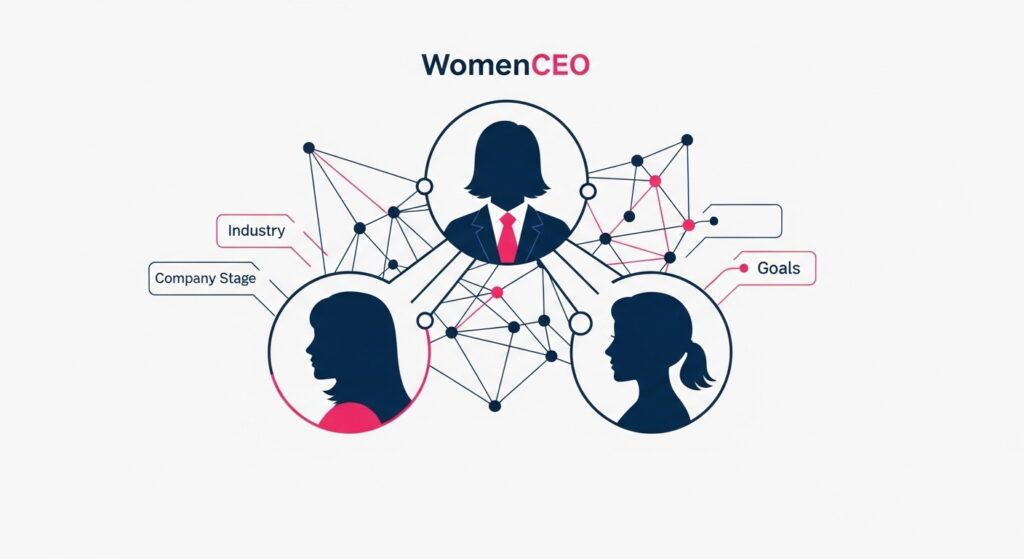
WomenCEO’s AI matching works from your profile: industry, company stage, specific challenges, goals, and gaps. The system surfaces mentor and peer matches based on those inputs, reducing the friction of finding the right person and increasing the likelihood of a useful connection.
- Matching considers industry, company stage, and stated challenges
- Reduces the cold-outreach problem that plagues self-directed networking
- Accountability group composition is informed by match data, not random assignment

5. Feature-by-Feature Breakdown
Feature |
Chief |
Ellevate |
WomenCEO |
|---|---|---|---|
AI-powered mentor matching
|
✗
|
✗
|
✓
|
Immediate access (no waitlist)
|
✗
|
✓
|
✓
|
Under $100/month
|
✗
|
Partial
|
✓
|
Peer accountability groups
|
✓
|
Limited
|
✓
|
CEO/founder-specific content
|
Partial
|
✗
|
✓
|
Live virtual sessions
|
✓
|
✓
|
✓
|
Job board / hiring features
|
✗
|
✓
|
✓
|
Free tier available
|
✗
|
✗
|
✓
|
Research & benchmarking
|
Limited
|
✓
|
Coming 2025
|
Note on the feature table: “Partial” indicates the platform offers something in this category but with significant limitations — geographic, tier-based, or in terms of depth. WomenCEO’s research and benchmarking features are in active development for 2025.

6. Who Each Platform Is Best For
Chief is best for:
Ellevate is best for:
WomenCEO is best for:
Women CEOs, cofounders, and growth-stage executives who want peer connection at their specific level, immediate access without a waitlist, AI-assisted mentorship matching, and founding member pricing that makes the ROI easy to justify. Especially valuable for entrepreneurs and mission-driven leaders who don’t have a corporate L&D budget behind them.
7. Start Free with WomenCEO
Most women’s networks ask you to wait. Wait for approval. Wait for the right cohort to form. Wait until your career hits a certain threshold before you’re considered eligible.
WomenCEO skips that. The platform is built on the premise that peer-level connection for women leaders shouldn’t require a 60,000-person queue or a $5,900 annual commitment to find out if it’s worth your time.
You get immediate access to AI-matched mentorship, peer accountability groups, and a community of women who are running companies and building things — at a founding member rate that won’t stay this low for long.
Ready to Stop Waiting and Start Leading?
WomenCEO gives you immediate access to AI-matched mentorship, peer accountability groups, and a community built specifically for women CEOs and founders. No waitlist. No gatekeeping. Founding member pricing won’t last.